
Everyone is racing to add AI.
AI chatbots. AI follow-ups. AI lead scoring. AI-generated campaigns. AI assistants that promise to run half your business while you sleep.
It sounds impressive.
But there is a problem.
AI built on scattered data just automates the chaos.
If your customer information is spread across inboxes, spreadsheets, accounting software and one team member’s memory, adding AI will not magically fix the foundation.
It will simply help you move faster in the wrong direction.
That is why a good CRM is still the heart of your marketing and sales system, even in the AI age.
The right order is simple: CRM first. AI second.
Build the foundation, clean up the process, then layer in automation and intelligence.
You can read the full Evolve With AI approach on our CRM and ERP Systems page.
Your business may already have a customer data problem
You may recognise some of these symptoms:
- ⚠ Leads sitting in inboxes, spreadsheets and sticky notes
- ⚠ Follow-ups missed because nobody owns the next step
- ⚠ Client history living in one person’s head
- ⚠ Sales, marketing, accounts and operations using separate systems
- ⚠ Double entry and manual copying between platforms
- ⚠ No clear view of your pipeline, revenue or customer value
- ⚠ AI tools being added on top of messy, inconsistent data
This is what we call Random Acts of AI.
A business buys a new tool because it looks useful. Then another. Then another.
Soon, there are plenty of tools but no connected system.
The issue is rarely a lack of software.
The issue is a lack of structure.
What a CRM actually does
A Customer Relationship Management system is not just a digital address book.
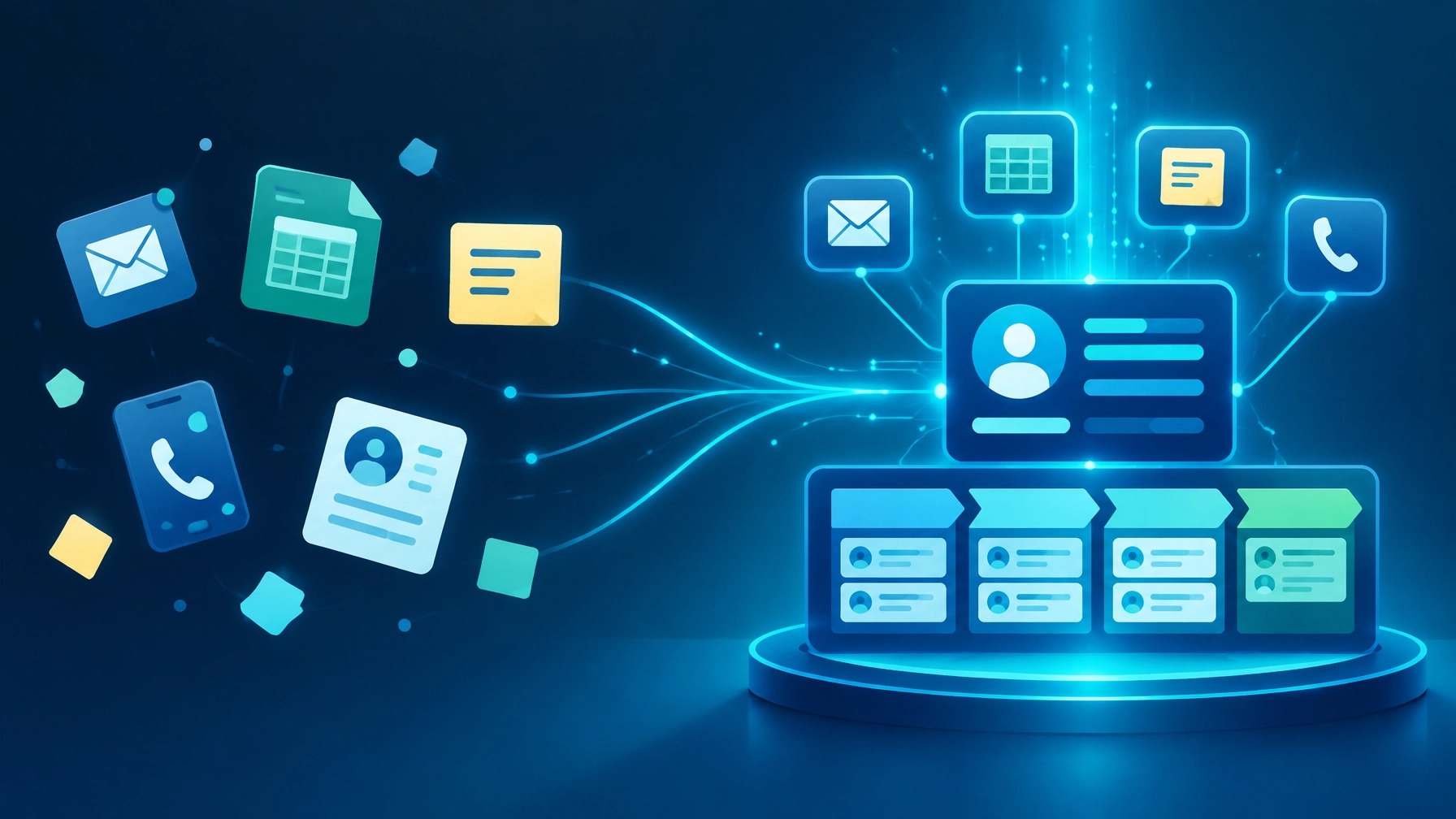
A good CRM creates one central place for your leads, clients, contacts and accounts.
It tracks the interactions that matter, including:
- Enquiries
- Calls
- Emails
- Quotes
- Sales
- Support requests
- Follow-up activity
- Customer preferences and history
This gives your team one shared view of every customer.
Less guesswork about what happened last time.
Fewer moments of asking, “Who was handling that?”
Less risk of losing valuable context when a staff member takes leave or moves on.
Your CRM becomes the operational memory of the business.
Why CRM still matters for small business in Australia
A CRM for small business in Australia does not need to be expensive or complicated.
It needs to be useful.
It needs to reflect the way your business actually works.
Most SMEs need a practical system that helps them:
1. Create one source of truth
Your customer information should be accessible in one reliable place.
That does not mean every system has to be replaced immediately. It means your CRM should become the centre of your customer data, with other systems connected where appropriate.
2. Stop losing leads
Every enquiry should be captured, assigned and followed up.
A lead should not disappear because it arrived while someone was on the road, in a meeting or away from the office.
3. Strengthen your marketing
A CRM helps you segment and understand your audience.
You can identify:
- ✅ New enquiries that need nurturing
- ✅ Existing clients ready for another service
- ✅ Customers who have gone quiet
- ✅ Prospects who received a quote but never proceeded
- ✅ Different groups that need different messages
That is how marketing becomes more relevant without becoming more complicated.
4. See your pipeline clearly
You should be able to answer basic questions quickly:
- What opportunities are active?
- What is likely to close this month?
- Which leads are stuck?
- Who needs a follow-up?
- Where is revenue coming from?
Without that visibility, you are managing the business by instinct.
5. Protect client relationships
When your team can see the full customer history, service becomes more personal.
You can understand the conversation before picking up the phone.
You can avoid asking customers to repeat themselves.
You can respond with context rather than starting from zero.
6. Keep knowledge in the business
Your customer relationships should belong to the business, not just to one employee or owner.
A well-used CRM supports continuity, onboarding and succession.
7. Prepare for AI
This may be the most important benefit now.
A CRM creates the structured, reliable data that AI needs to do useful work.
AI does not replace the CRM
A common question is:
“If AI can search, summarise and automate information, won’t it replace the CRM?”
Not really.
AI makes structured customer data more valuable, not less.
Think of your CRM as the business memory.
AI is the layer that reads that memory, identifies patterns and helps you act on it.
A chatbot without customer history gives generic answers.
An automation without pipeline data triggers the wrong follow-up.
A sales assistant without accurate records makes poor recommendations.
AI without a good CRM is clever software working with incomplete instructions.
With a solid CRM underneath, AI can help you:
- ✅ Capture and qualify new leads automatically
- ✅ Trigger follow-ups and nurture sequences
- ✅ Summarise client interactions
- ✅ Prepare meeting briefs
- ✅ Help forecast sales and flag potential risks
- ✅ Flag clients who may be disengaging
- ✅ Draft relevant communications
- ✅ Power chatbots with real customer context
- ✅ Reduce repetitive administration across the team
That is the difference between AI as a shiny add-on and AI workflow automation that supports real business outcomes.

CRM and ERP for SMEs: connect outwards as you grow
Your CRM is the centre of the customer relationship.
An ERP, or Enterprise Resource Planning system, connects the wider business around it.
Together, CRM and ERP for SMEs can link the full journey from first enquiry to final invoice:
- Marketing and lead capture
- Sales and quoting
- Accounting and invoicing
- Projects and service delivery
- Inventory and purchasing
- Support and client success
The result is less double handling, fewer errors and better visibility across the business.
But you do not need to connect everything on day one.
Start with the CRM at the centre. Then connect outwards as your needs grow.
This is where strategy first, software second matters.
Enterprise platforms such as HubSpot and Salesforce can be powerful, but they are often priced and designed for much larger organisations.
Most SMEs do not need every feature on a vendor’s list.
They need the right-sized system for their customers, team, budget and existing tools.
A practical five-phase approach
Our founder brings more than 20 years of hands-on CRM and ERP experience gained across multiple businesses.
We have seen what works.
We have also seen why rollouts fail: no strategy, no process mapping and no adoption plan.
Our approach is straightforward.
Phase 1: Discover and assess
We understand your business, customers, current systems and pain points.
Phase 2: Map and plan
We map your workflows, define the requirements and create a practical CRM or ERP roadmap.
Phase 3: Select and build
We recommend and configure a right-sized CRM based on your budget and setup, not a generic software wish list.
Phase 4: Integrate and automate
We connect the surrounding systems and layer in AI automation where it will create measurable value.
Phase 5: Train, optimise and evolve
We support team adoption, improve the system over time and help your business keep moving forward.
Slow down to speed up.
A few weeks of strategy can save years of workarounds.

A quick CRM self-check
Before buying another AI tool, ask yourself:
- ✅ Where does your customer and lead data currently live?
- ✅ Can every team member see the same customer history?
- ✅ Are new leads captured automatically?
- ✅ Does every lead have a clear owner and next step?
- ✅ Can you see your pipeline and expected revenue?
- ✅ Are sales, marketing, accounting and service systems connected?
- ✅ Are you entering the same information more than once?
- ✅ Would your business keep its customer knowledge if one person left?
- ✅ Is your CRM clean enough for AI automation?
- ✅ Does your team actually use the system?
If several answers are uncomfortable, that is useful information.
It means you may need to strengthen the foundation before adding more intelligence.
Keep Australian privacy obligations in view
Customer data should be handled carefully, particularly when AI and automated decision-making are involved.
From 10 December 2026, new transparency obligations under the Australian Privacy Act will apply to certain automated decisions that use personal information and could significantly affect an individual’s rights or interests.
These obligations apply to organisations covered by the Privacy Act (known as APP entities). Many small businesses with turnover under $3 million are exempt, though important exceptions apply — including for health services, businesses that trade in personal information, and those contracted to the Commonwealth. If you're unsure whether you're covered, it's worth checking. We covered the small business coverage question in more detail in our earlier article on the topic.
The exact obligations depend on how your business uses personal information and automated systems.
However, the practical lesson is clear:
- ✅ Know what customer data you hold
- ✅ Know where it came from
- ✅ Keep it accurate and secure
- ✅ Be clear about how it is used
- ✅ Keep humans involved in significant decisions
- ✅ Make automated processes explainable where required
Clean, well-governed CRM data makes this work far easier.
For detailed guidance, review the OAIC information on APP 1 and open, transparent management of personal information.
Build the base before you add the intelligence
You do not need to implement every AI tool available.
You do not need an oversized enterprise platform.
You do need a clear view of your customers, a reliable process and a CRM your team will actually use.
Great AI business automation in Australia starts with good business foundations.
If you are unsure whether your current setup is helping or holding you back, complete the CRM Health Check. It looks at where your customer data lives, how leads are captured, which systems you use, where double handling occurs and what your priority areas are.
We can then recommend a CRM and ERP pathway that fits your needs and budget.
Or, if you would prefer to talk it through first, book a free 15-minute discovery call.
No pressure.
Just a practical conversation about where you are now, what is getting in the way and what a sensible next step could look like.
This article provides general information only and is not legal, financial or technology procurement advice. It does not take into account your objectives, circumstances or needs, and should not be relied upon in place of advice from a qualified professional. Privacy and AI obligations depend on your circumstances — we recommend obtaining independent legal or privacy advice before making decisions about your data or systems. Nothing in this article creates a client, advisory or professional relationship with Evolve With AI, and we make no representation or warranty as to the suitability of any platform mentioned for your business. Any AI-generated output should be reviewed by a suitably authorised person before it is relied upon or sent to a customer.
HubSpot and Salesforce are trademarks of their respective owners. Evolve With AI is not affiliated with, endorsed by, or partnered with these platforms.